

- The US Treasury said the main purpose of its Treasury buybacks is to improve trading in older bonds and make cash management more efficient.
- The article said high US Treasury yields can weigh on growth stocks and heavily indebted companies by affecting the present value of future earnings and interest costs.
- The article said Korean investors should watch US interest rates, Treasury yields and the won-dollar exchange rate together, weighing both price risk and currency risk.
Forecast Trend Report by Period


This article was published on Hankyung Premium 9, the Korea Economic Daily’s paid investment platform. Subscribers to Hankyung Premium 9 can access more stock-investment stories at www.hankyung.com/premium9.
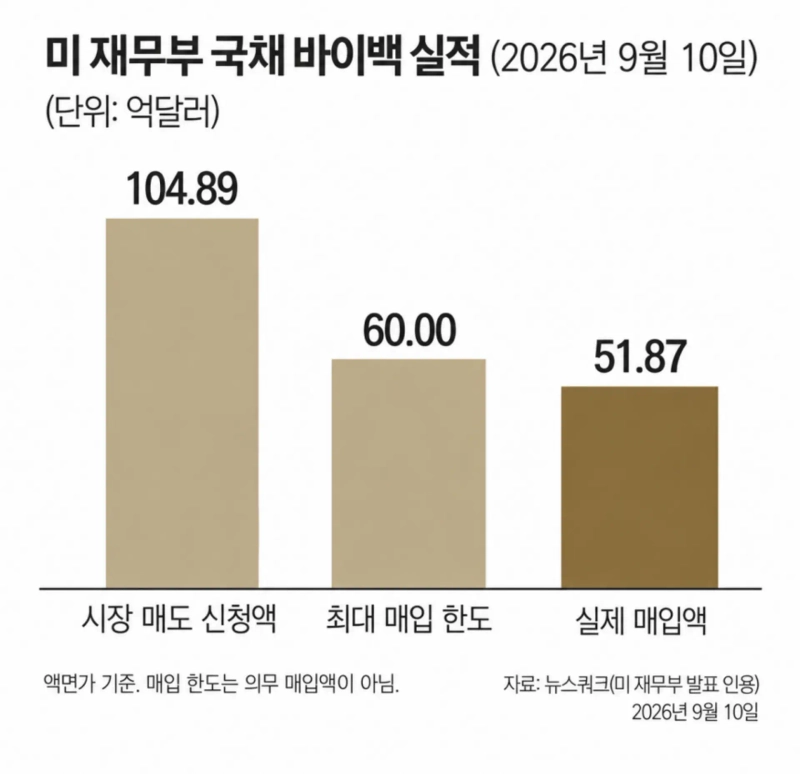
The US Treasury recently received offers to sell back $10.489 billion of Treasuries, but purchased only $5.187 billion. It could have bought as much as $6 billion, but did not use the full limit. The amount offered for sale was nearly double the cap.
That reflects how the Treasury’s buyback program works. It evaluates submitted bonds based on market prices and relative value at the time of the operation. Even when sale offers exceed the cap, the Treasury does not have to fill the full amount.
That has underscored that Treasury buybacks are not a policy of indiscriminately purchasing bonds to drive yields lower. The program is meant to support market functioning, but the Treasury can decline to buy securities it views as too expensive. Even so, markets had widely expected that a larger buyback program would lift Treasury prices and push yields down.
Actual Buyback Volume Was 86%
According to TreasuryDirect, the Treasury’s debt-information website, the Sept. 10 buyback targeted nominal Treasuries with 10 to 20 years remaining to maturity. The Treasury said it would buy up to $6 billion and ultimately purchased 86.45% of that amount. The $6 billion figure, however, was based on par value. Because par value refers to principal repaid at maturity, it does not necessarily match the amount of cash the Treasury actually paid that day.
The Treasury screens submitted sell orders based on market price and relative value. It is not required to accept all bonds offered at elevated prices. Even when bids exceed the cap, the government has no obligation to take every price level. That is why a purchase amount below the cap does not by itself mean the operation failed.
Nellie Liang, then the Treasury’s under secretary for domestic finance, said in 2023, when the framework was being designed, that “the objective is not to buy a particular quantity of securities.” The mechanics make it easier to understand why the Treasury buys selectively. Newly issued Treasuries tend to attract the most trading. Older securities, by contrast, can be relatively harder to buy and sell even though they carry the same US government backing. By regularly purchasing those older bonds, the Treasury gives investors a channel to convert them into cash.
That reduces the need for investors to slash prices when they need to sell quickly. Financial firms that intermediate bond trading can also sell Treasury holdings to the government and redeploy the proceeds into other transactions. If Treasuries become easier to trade, investors may demand a smaller liquidity premium for the risk that the bonds will be harder to sell later.
The Treasury itself does not appear to believe this round of buybacks can dictate market yields. Treasury Secretary Scott Bessent recently said the government “cannot change the equilibrium price.” Jim Barnes, a fixed-income director at Bryn Mawr Trust, told Reuters that the $6 billion cap “is not a large amount.”
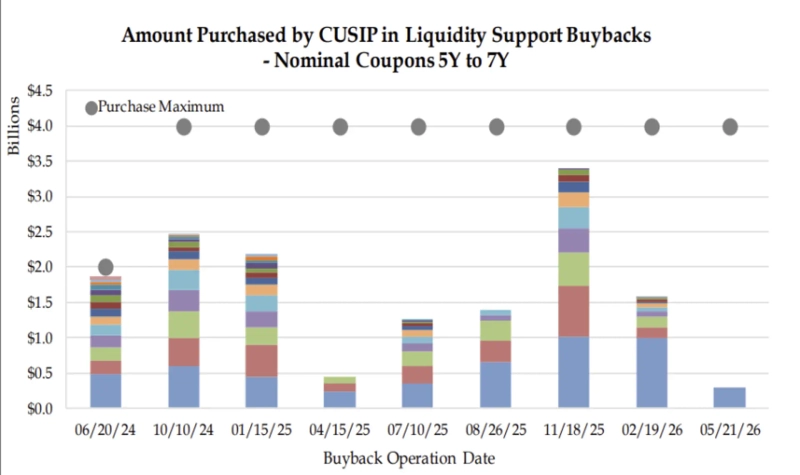
This purchase was the first case in which the Treasury applied its previously announced expansion of buybacks. Last month, it said the per-operation cap for purchases of Treasuries with 10 to 20 years and 20 to 30 years remaining to maturity would rise from $2 billion to at least $4 billion. The expanded limits apply from Sept. 9 through Nov. 4, when the Treasury is scheduled to announce its next quarterly borrowing plan. In the Sept. 10 operation, the cap rose to $6 billion.
But the larger buyback did not immediately pull long-term yields lower. Data from FRED, the database maintained by the Federal Reserve Bank of St. Louis, show the 10-year Treasury yield rose to 4.95% on Sept. 10 from 4.78% on Sept. 4. The 30-year yield climbed to…
Read More: Why the US Treasury Isn’t Buying Bonds Blindly: The Real Purpose of Buybacks